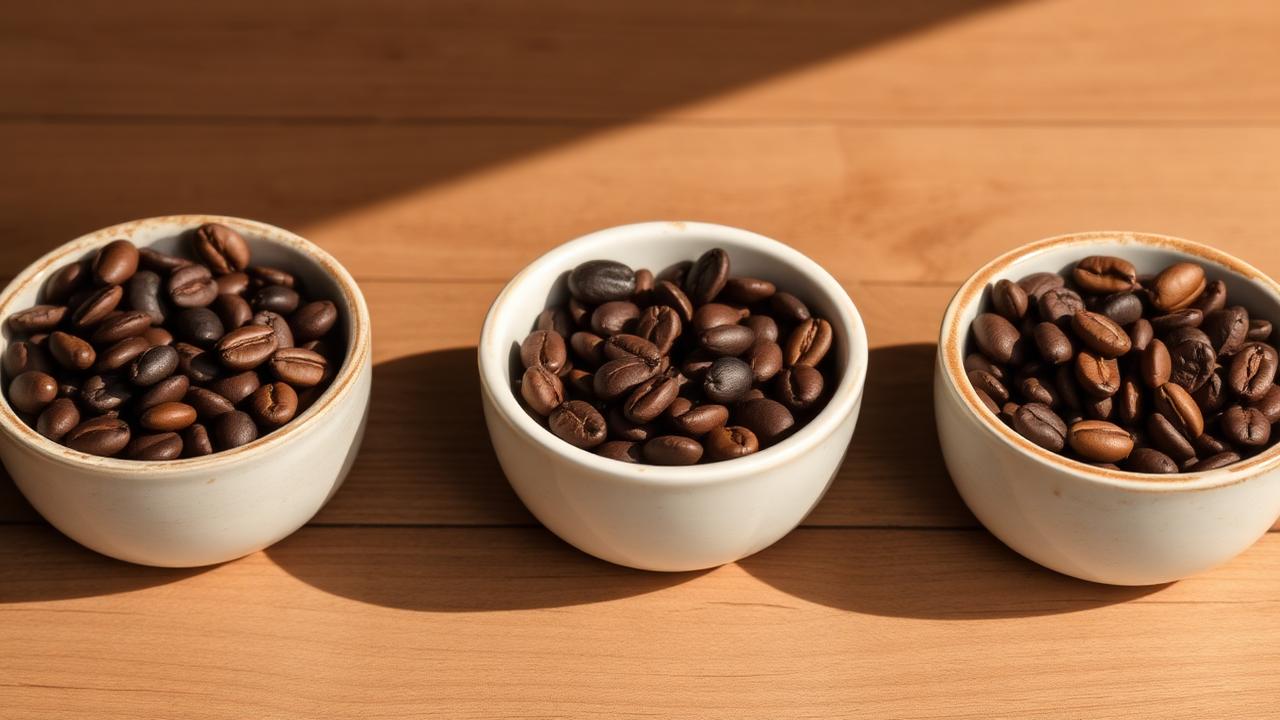
Roast level is a label that may appear on a coffee bag, but roasters do not always use terms such as “light,” “medium” and “dark” in exactly the same way. One roaster's “medium” may differ from another's, and a label can cover a range of development. Understanding common roasting cues gives context for the words on a bag, but it cannot tell you exactly how a coffee will taste or how it must be brewed.
What happens inside the bean
Green coffee changes as it is heated: it dries, expands and undergoes chemical reactions that create or transform aroma and flavour compounds. Roasters discuss processes such as the Maillard reaction and caramelisation, but a finished cup cannot be explained by one reaction alone. Bean variety, growing conditions, processing, roast profile and development all contribute to the flavours described as nutty, bready, chocolate-like or savoury.
First crack is an audible phase many roasters use as a reference point; the sound and its timing vary with the coffee, roaster, batch and listening conditions. Second crack may also be used as a roast-development cue, but it is not always reached and is not a universal definition of “dark.” Temperature readings depend on probe placement and equipment, so a number from one roaster should not be presented as a universal bean temperature.
Roasters may use the interval around these cues to make decisions, but there is no single timing rule that defines all specialty roasting. Changes to a profile can affect a cup, although the result depends on the coffee and the full roast curve rather than one isolated number of seconds.
Light roasts
“Light roast” is a broad commercial and conversational label, not a measurement that guarantees a particular development or flavour. Lighter-looking coffees may retain more of the characteristics associated with origin and processing, but roast profile, green coffee and brewing all shape what is noticeable. Appearance and tasting notes are clues rather than direct measurements of density or quality.
Some lighter roasts may respond well to more heat, finer grinding or longer contact than a darker coffee in the same setup, but this is not universal. If a cup tastes sharp, thin or dry, those words describe your experience; they do not prove that the coffee is defective or under-extracted. Repeat the recipe and change one variable at a time.
Choose a temperature, ratio and grind as a starting recipe for your brewer, then record how the coffee tastes. Brew Bench's Water Temperature Guide Calculator offers a suggested starting point based on selected inputs; its result is not a roaster-specific measurement or guarantee. For espresso, resting time and ratio also vary by coffee and equipment.
Medium roasts
“Medium” is used differently by roasters and markets, so two bags with that label may not look or taste alike. Some medium roasts balance roast-derived flavours with flavours associated with the green coffee, but that balance is not automatic. Look at the roaster's description and taste the coffee rather than assuming a fixed position between two crack events.
A medium roast can be a convenient coffee for practising a new brewer, but it is not inherently the easiest or most forgiving. Use a familiar recipe, keep the dose and water repeatable, and adjust according to the cup. A starting temperature or ratio can be useful for comparison; it should not be described as a standard that works without adjustment.
Use the tool: the Water Temperature Guide Calculator offers an in-site starting estimate from selected roast, method and grind inputs. It does not measure the water, account for every kettle or brewer, or certify a target for a particular coffee.
Dark roasts
“Dark roast” can refer to a range of appearances and development. A darker roast may show stronger roast-derived flavours, and some beans develop surface sheen, but sheen alone does not prove a particular crack stage. Notes such as chocolate, smoke or molasses describe possible impressions, not a required profile.
Dark coffees may taste different when brewed with the same parameters as a lighter coffee, so temperature, grind, ratio or contact time can be worth testing. Begin with one measured change and decide from taste. There is no universal cooler-temperature band or extraction speed for every dark roast, grinder and brewer.
Storage changes depend on the coffee and its packaging. Oil on the surface is not a reliable freshness test by itself; use the roast information when available, store beans carefully and taste the cup. If it tastes stale or unpleasant, note that observation without assuming the cause from appearance alone.
Reading a bag without a roast-level label
Appearance can help you compare two bags, but it does not provide a calibrated roast measurement. Lighting, bean variety, processing and surface oils affect what you see. Use a bag's roast label as the roaster's description, and ask for clarification if the distinction matters to your brewing choice.
Tasting notes such as jasmine, bergamot, peach, chocolate or smoke are descriptive prompts. They do not reliably identify a roast level or prove that a coffee contains a particular flavour compound. A bag can name more than one impression without being a blend or misleading; taste it and decide whether the description is useful to you.
Roast level is not quality
It is easy, in specialty circles, to treat light as sophisticated and dark as crude. That is a preference dressed up as a hierarchy. A well-executed dark roast of good green coffee — developed evenly, dropped before the ashy phase — is a coherent, deliberate product with real craft behind it. A badly executed light roast, dropped so early that the interior is underdeveloped, tastes of raw peanut and grass no matter how expensive the beans were.
The useful question is not how light the roast is but whether the roast is developed: whether the interior of the bean has been carried far enough that the sugars have reacted. Underdevelopment is the actual defect, and it can occur at any colour.
Practical takeaways
- Light roast: try a small grind or temperature adjustment only if your repeatable starting recipe needs it.
- Medium roast: use as one possible practice coffee, not as a universal calibration standard.
- Dark roast: compare a modest change in ratio, temperature or grind if you prefer a different balance.
- When a coffee tastes wrong to you, check the recipe and the bag information; roast label alone cannot diagnose the cause.