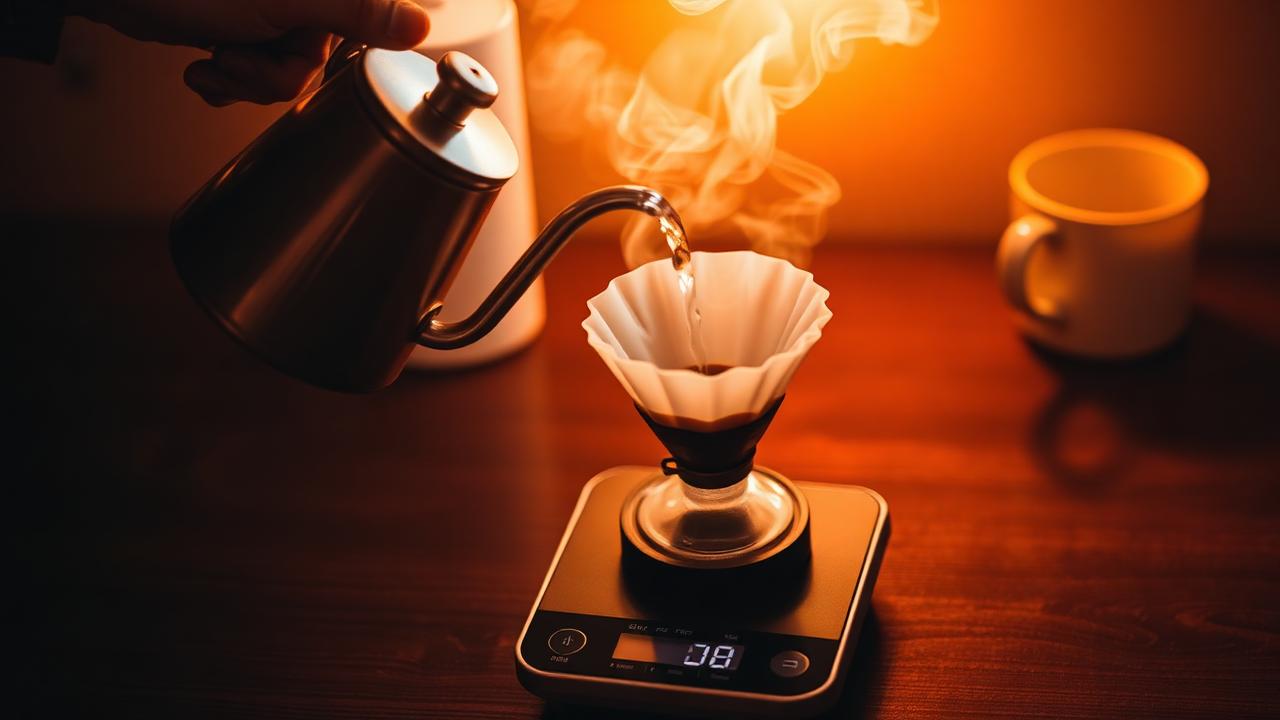
A pour-over can taste different from one brew to the next when dose, water temperature, pouring or timing changes. Those differences are easy to miss if you do not record the recipe. A short log gives you something to compare before blaming the coffee or changing several parts of the method.
Repeatability comes from deciding, in advance, what you will hold constant. Dose, ratio, grind and pour schedule are useful places to begin, but brewer shape, filter paper, water, temperature and pouring technique can matter too. You do not need to control every detail at once; choose a simple recipe, record the important inputs and change one thing when you have a reason.
1. Choose a repeatable dose
Choose a dose that fits your dripper and the amount you want to serve. Cone sizes such as 01 and 02 are not interchangeable across every maker, so check the manufacturer's stated capacity and use that as a starting point. A smaller dose can behave differently from a larger one because bed depth and water flow change; it is not automatically uneven or unusable.
Weigh the dose every time. Scoops vary with bean density, shape and fill level, so the same scoop can represent materially different masses. A scale turns the dose into a repeatable input.
2. Start with a measured ratio
For a first comparison, try 15 g of coffee with 240 g of water, a 1:16 ratio by mass. This is an example recipe, not a range that covers every roast or brewer. If the cup tastes too concentrated or too weak to you, test a different ratio; if its flavour balance seems off, grind or contact time may also be worth testing. Words such as sour and bitter are observations, not diagnoses by themselves.
Use the tool: the Coffee to Water Ratio Calculator solves for any missing value, so you can scale a 15 g recipe to a 500 g carafe without arithmetic mistakes.
3. Record grind and contact time
Grind size can affect how quickly a brew drains, but it is not simply a time dial. For the example recipe, record total brew time as a way to compare your own attempts rather than treating one time range as a universal target. A fast drawdown may come from grind, pouring, filter or dose; a slow one may have several causes too. Taste the cup and inspect the process before deciding which adjustment to test.
Change grind in a small step that makes sense for your grinder, and keep other inputs steady when possible. One change at a time makes the comparison easier to interpret, although it cannot remove every source of variation.
4. Write the pour schedule down
A pour schedule turns an improvisation into a procedure you can repeat. Here is one example for a 15 g dose and 240 g of water; adapt the stages to your dripper, filter and preferred cup:
- 0:00 – 0:45 — add an initial portion of water and make sure the grounds are wet; the amount can be adjusted to the dose and coffee.
- 0:45 – 1:15 — add water toward an intermediate total, using a pour pattern you can repeat.
- 1:15 – 1:45 — add the remaining water in a controlled pour.
- After the final pour — let the bed drain and record the finish time. Swirling is optional; use it only if it helps your method.
Read the schedule off a timer rather than from memory. The Multi-Stage Brew Timer lets you enter these stages once and get an audible cue for each one.
Diagnosing the cup
- Sharp or thin: record the taste and repeat the same recipe before deciding whether to adjust grind, temperature or ratio.
- Dry or heavy: try one small change, such as reducing agitation or adjusting grind, and compare it with your baseline.
- Balanced but weaker than you prefer: test a slightly tighter ratio while holding other inputs steady.
- Harsh at the end: check the brew bed, filter and pour pattern, then alter one step; flavour alone does not prove an uneven bed.
A simple way to compare brews
Brew the same coffee with the same recipe for several trials before changing a variable. You may learn which version you prefer and how small changes affect that particular coffee in your setup. The result will not necessarily transfer to every bag; a different coffee, roast, grinder or filter can behave differently. Keep the notes as a useful reference, not as a universal rule.
Use the numbers as a record, not a promise
A recipe can make your next trial easier to compare, but it cannot guarantee a particular flavour. Coffee, water, filter paper, grinder condition, room temperature and technique all change the brew. Treat dose, water mass, time and grind setting as observations that make a change visible. Then decide from tasting whether the change helped. This is more reliable than treating any timing window or ratio as a pass-or-fail rule.
When a result surprises you, first check the things that are easy to verify: scale tare, water mass, the correct filter, an even wet bed and the grinder setting recorded for that day. If those are consistent, choose one next adjustment. You might change the grind slightly, alter the ratio, or simplify the pour schedule. Avoid changing every variable after a disappointing cup; that erases the comparison you just paid coffee to make.
Write an observation you can use later
A short note is enough: coffee name, roast-date information if supplied, dose, water, setting, total time and one or two sensory observations. “More drying than yesterday; flow slowed after the second pour” is a useful note because it names what happened. “Bad coffee” is not. You do not need to identify a chemical cause to keep a valuable brewing record.
If you are learning a new brewer, begin with the manufacturer’s stated capacity and filter guidance, then use a conservative recipe that fits the brewer comfortably. A larger or smaller batch may need different technique, even when the ratio is unchanged. The Recipe Scale Calculator preserves the arithmetic of a recipe; it does not promise the same drawdown or cup at another batch size.
When to stop adjusting
Stop when the cup is repeatable and enjoyable for you. Precision is useful because it helps you return to that point, not because it makes every brew objective. Brew Bench’s calculators provide transparent arithmetic and prompts for notes; taste remains the final check.